Saturday, January 15, 2011

January Roundup - #133

It's been a great January. I've really come to enjoy winter birding. In some ways it's easier to find birds in the winter... just look where the food is and there they'll be! Plus they sometimes stand out more in the leafless trees or snowy backdrops. There may not be quite as many birds around but the ones that hang in there through the winter with you sure gain your admiration and respect.

Today was the Bird Club breakfast at the Wilderness Center in Wilmont. It was a really good turn out and I counted 21 different species of birds:

Eastern Towhee
Red-winged Blackbird
Tufted Titmouse
Brown-headed Cowbird
White-breasted Nuthatch
Carolina Chickadee
Northern Cardinal
White-throated Sparrow
Song Sparrow
House Sparrow
Common Grackle
American Tree Sparrow
White-crowned Sparrow
Red-bellied Woodpecker
Blue Jay
Mourning Dove
Dark-eyed Junco
Downy Woodpecker
American Goldfinch
American Crow (HO)
Black-capped Chickadee (Prob)

The drive home was no let down either! I added another lifer to my list as well as two other decent birds. Thanks to Levi Yoder for letting us tromp around his property until we could find my life bird #133, the Common Redpoll! A really good looking bird. We heard more calling from the woods, but only one was venturing out to the feeder at the time.

Common Redpoll, Identification, All About Birds - Cornell Lab of Ornithology

The two other birds of note were Black Vulture and A flock of about 30-40 Horned Lark hanging in the fresh manure... Got to love the farm country :) Today's birds put me at 40 species for my year list. Feelin' purty darn good about the year so far:)

Photo Credits:
Common Redpoll - Cephas

Saturday, January 1, 2011

Out with the old.... #131 - #132

Well it's the new year, but I had two more birds in before the end of last year. Final count...... 132!!!!!!!!!!!! What a great year. I didn't make my second goal of 150 birds, but I think I did pretty good considering I started in June as well as having our third child in June! The last two rascals to wrap it up?

1) Wilson's Snipe

I saw a pair of these wonderful winter shorebirds on a back country road dipping about in a spring fed stream. The stripes on the back and detailed pattern on the flanks are particularly cool, as is the long beak and small body. A good bird.

2) Rough-legged Hawk

On the same back road though on a different day. It's so nice to see something that's NOT a Red-tailed Hawk! Of note was the dappled gray back, a bit of white on the rump above the tail (similar to a Northern Harrier) and the bold black band at the end of the tail underside.

So there you go. 2010 all wrapped up with a bow on and 2011 staring us in the face with the promise of more birds to come. I hope you enjoyed my voyage to the New Year. I know I certainly did. Tune in in 2011 to see where I can take it from here. I can tell you this, I know where I'll be come May. It's Warbler time....


Photo credits:

Wilson's Snipe - Alan D. Wilson
Rough-legged Hawk - Walter Siegmund

Tuesday, December 7, 2010

Peanut Butter Jar Feeder

I really enjoy making my own bird feeders, not only for the money I save but also for the creative satisfaction. This is a design for a Peanut Butter jar (plastic) feeder that is fairly easy to make. I'm still working out the kinks, some of which depends on the plastic you are using. Too hard and it can crack or tear, too soft and it tends to melt. Here it is step by step:

Material list:

* Peanut butter jar (or any plastic, lidded container)
* Two camp plates or similar (small frisbees would work)
* Drill with 1/8", 1/4" and 1/2" bits
* 1 stainless steel binding post (1/4" wide by 1" long)
* Washers - 2+ stainless and 1 rubber
* Eyebolt with two nuts
* 3/4" piece of cedar for a spacer
* Jigsaw (to cut out the spacer).


Check out the photos and customize as you see fit

1) Drill 1/4" holes in the center of both plates, jar lid and jar bottom.


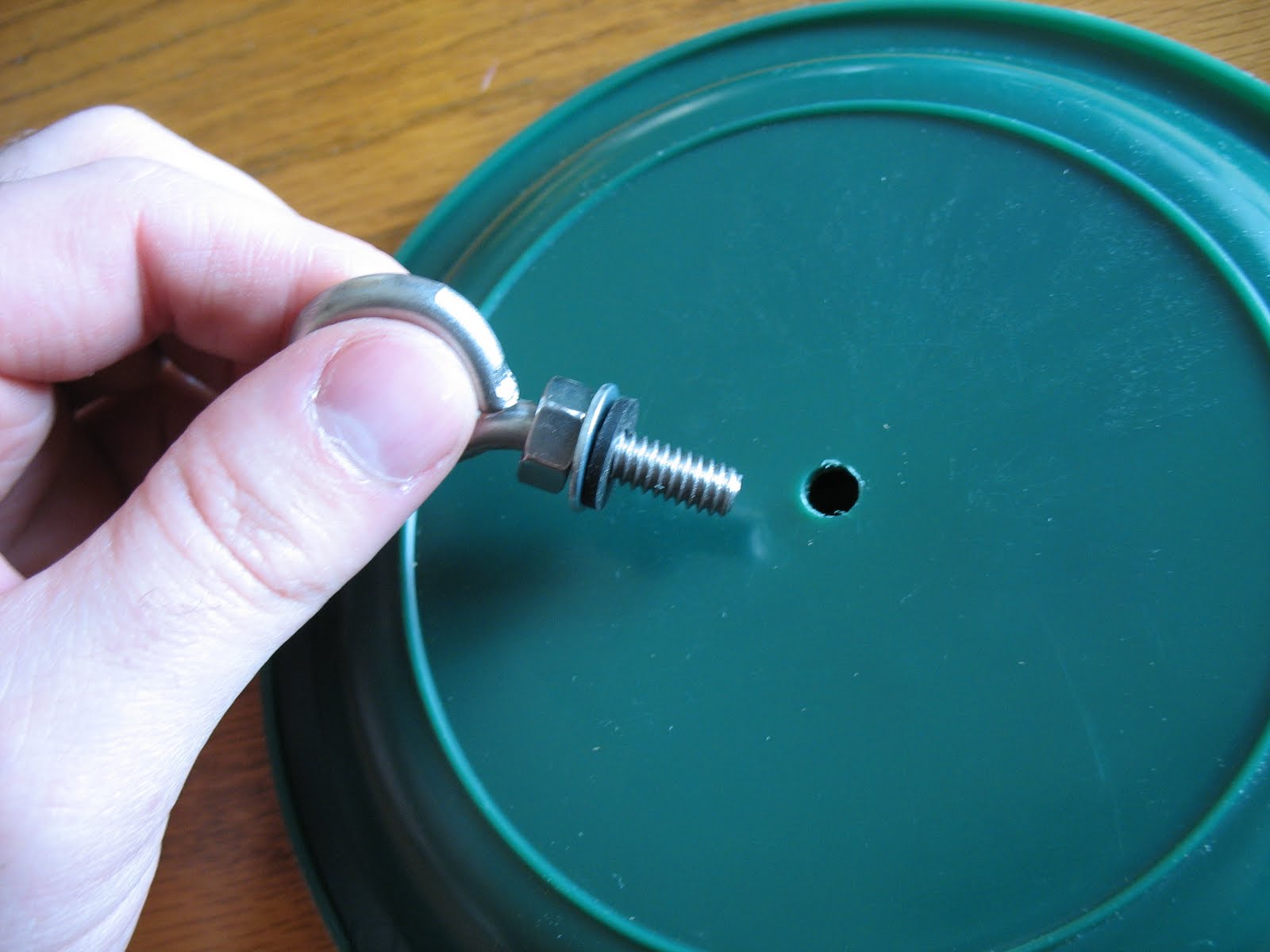
2) Assemble top and bottom hardware with plates and jar pieces


Use the rubber washer along with a normal washer to keep water from leaking in beneath the eye bolt. (This is going to be the top of the feeder). Secure inside the jar with the other nut / washer.


Use the binding post to fasten together the bottom plate, lid and wooden spacer.


To make the spacer I simply found a smaller lid that fit inside the peanut butter jar lid and used it as a template to trace and then cut out a circle from a piece of cedar. The reason for this spacer is to keep seed from resting below an accessible eating place (you'll see why when it all comes together). Be sure to not cut too large a diameter circle. It needs to freely fit inside the peanut butter jar. Use washers as needed to securely join the assembly.

3) Drill two 1/2" holes along the top edge of the jar near the screw threads. This will actually be the bottom of the feeder and allows seed to pour out into the "tray".


4) Drill two 1/4" holes about 1 1/2" to 2" above the threads for birds to feed higher as well. (Not shown).

5) You can trim the excess plastic around the drill holes with a sharp razor blade. This time I used a lighter to heat seal it. I didn't like the results so much because it lost it's clean look. Still it's functional and the birds are eating from it.


6) Drill some 1/8" (or smaller) holes around the bottom tray for drainage.


7) The finished feeder!!!

Thursday, December 2, 2010

Feeder Bird #16

White-throated Sparrow! What an awesome winter guest. If you've ever heard the Autumn call of "Old Sam Peabody Peabody Peabody" then you've heard the distinctive song of the White-throated Sparrow.


Photo Credit:
Tattooeddreamer

Wednesday, December 1, 2010

Duck!! #126 - #130

Yet another great day of birding around the Shreve and Funk areas. Greg Miller and I left about 7:45 in the hopes to spot some Sandhill Cranes. It turns out more was on the menu!! Our first stop was Shreve lake. We set up the scope and scanned the area: Hooded Merganser, Great-blue Heron, Pied-billed Grebe and a lifer for me - Ruddy Duck.

Ruddy Duck, Identification, All About Birds - Cornell Lab of Ornithology

We got turned around a bit on the way to Funk Bottoms, but it turned out to be a God direction. Just outside of Blachleyville at the Church of Christ church, stood a group of 26+ Sandhill Crane. They were close enough for me to fire off some photos through my binoculars, one of which turned out OK. Awesome birds. How cool to think that we get birds this size in Ohio every year.

Sandhill Crane, Identification, All About Birds - Cornell Lab of Ornithology

The Funk observation platform served up a real treat too. As we scanned the fields beyond, another flock of 86+ Sandhill Crane flew in and circled a few times, trumpeting before landing. What a majestic sight! But that's not all, hunting in the same fields, lazily gilding in flight, was a female Northern Harrier.

Northern Harrier, Identification, All About Birds - Cornell Lab of Ornithology

Last stop: Killbuck Marsh area. Most of the water was frozen over, but a few thawed areas served as congregation spots for over 150 American Coots as well as several species of duck, including two new species for me: Ring-necked Duck and Bufflehead.


Ring-necked Duck, Identification, All About Birds - Cornell Lab of Ornithology


Bufflehead, Identification, All About Birds - Cornell Lab of Ornithology


View Birding 11/29/10 in a larger map

Photo Credits:

Ruddy Duck - Dick Daniels
Northern Harrier - Kevin Cole
Ring-necked Duck - Lee Karney (Fish & Wildlife Service Employee)
Bufflehead - MDF